
With Dekra Sefty Comes First
Testing company Dekra ensures reliably and impartially that Vahterus heat exchangers meet all safety requirements.
Vahterus Editorial Team
Dekra is an independent testing company with official authorisation. The company is focused on technical inspections, conformity assessments, testing and certifications in different areas of industry. The purpose of its operations is to reliably and impartially ensure that basic safety requirements are met.
The design and manufacture of pressure equipment is regulated by legislation and, in addition to EU directives and standards, is subject to national regulations. Vahterus heat exchangers are welded pressure vessels that by law must be subjected to non-destructive material testing. Dekra is Finland’s leading expert in non-destructive testing and Vahterus’ chosen partner in this work.
Dekra Industrial Oy began its operations in Finland in 1974 under the name Polartest Oy. Today, the company is owned by Dekra SE, the third largest inspection and testing company in the world, with headquarters in Stuttgart, Germany. Vahterus began working with Polartest 25 years ago. With Dekra’s acquisition, Polartest became part of Dekra, and the collaboration with Vahterus continued.
‘For Vahterus, cooperation with Dekra is important’, says Matti Kontu, Production Director at Vahterus, ‘because its work is necessary for showing that the pressure vessel and its welds meet all the requirements’. The quality of metal structures can be measured by both breaking the material (DT, destructive testing) and without breaking the material (NDT, non-destructive testing). NDT looks for surface or hidden deficiencies in the material that may lead to failures or malfunctions. Research methods include surface and volumetric inspections.
At Vahterus, virtually all basic testing methods are used, says Jarmo Aitta, Regional Manager at Dekra. ‘Applied surface inspection methods include visual testing, magnetic-particle testing and liquid penetrant testing. Fluorescent methods have also been used, but less frequently. In volumetric inspection, the most used methods are radiographic and ultrasound testing. Lately, there’s been an increase in the use of digital radiography and phased array ultrasound testing.’
NDT is standardised, and at Vahterus, testing is performed by Dekra in two shifts daily. Four people work per shift and practically every product on the production line undergoes some non-destructive testing. The radiation space is lined with lead, which enables the use of radiography during a normal shift. All testing is performed at the Vahterus premises, but the testing equipment is the property of Dekra.
The test regulations and scope come from pressure vessel legislation, so that’s not really in our hands’, says Kontu. ‘However, the more consistent the quality of Vahterus production is, the fewer errors are found in the tests, which then minimises the need for corrective work. The error rate is constantly monitored at the level of the entire production as well as the personal level of each welder.’
Aitta reports that the inspection methods have developed greatly over the years, and at Vahterus it has always been possible to introduce the most advanced methods at an early stage. Besides testing, the heat exchangers and their materials have evolved, which has led to new challenges in different inspection methods.
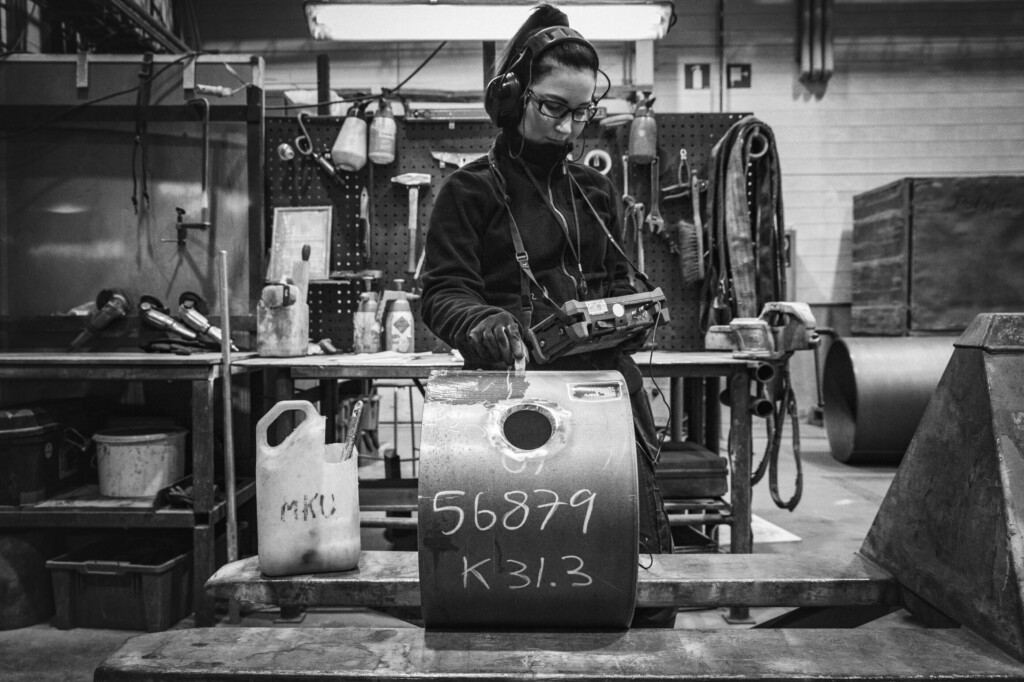
NDT is standardised, and at Vahterus, testing is performed by Dekra in two shifts daily.
‘I personally think that Vahterus has invested in quality and strived to develop both welding methods and processes that alleviate testing. Various inspection-related aids have been created or even purchased for our assistance. Dekra has also been involved in testing new products made using new welding methods and production equipment already in the pilot phase. This has further increased the inspectors’ motivation and expertise’, says Aitta.
Dekra is also one of Vahterus’ partners in destructive testing, as well as in the supervision of welding- method tests and proficiency tests. Destructive testing is performed on welds and base materials.
One of the key areas in the collaboration between Dekra and Vahterus has been the development of working methods and information systems. About five years ago, a new documentation management system was introduced, and for the past two years, all of Dekra’s inspection reports have been completed electronically. The reports are automatically transferred to Vahterus’ system within one hour of signing. All reports are also available to the inspectors who visit Vahterus, which makes it easier to keep track of the inspections and write new reports.